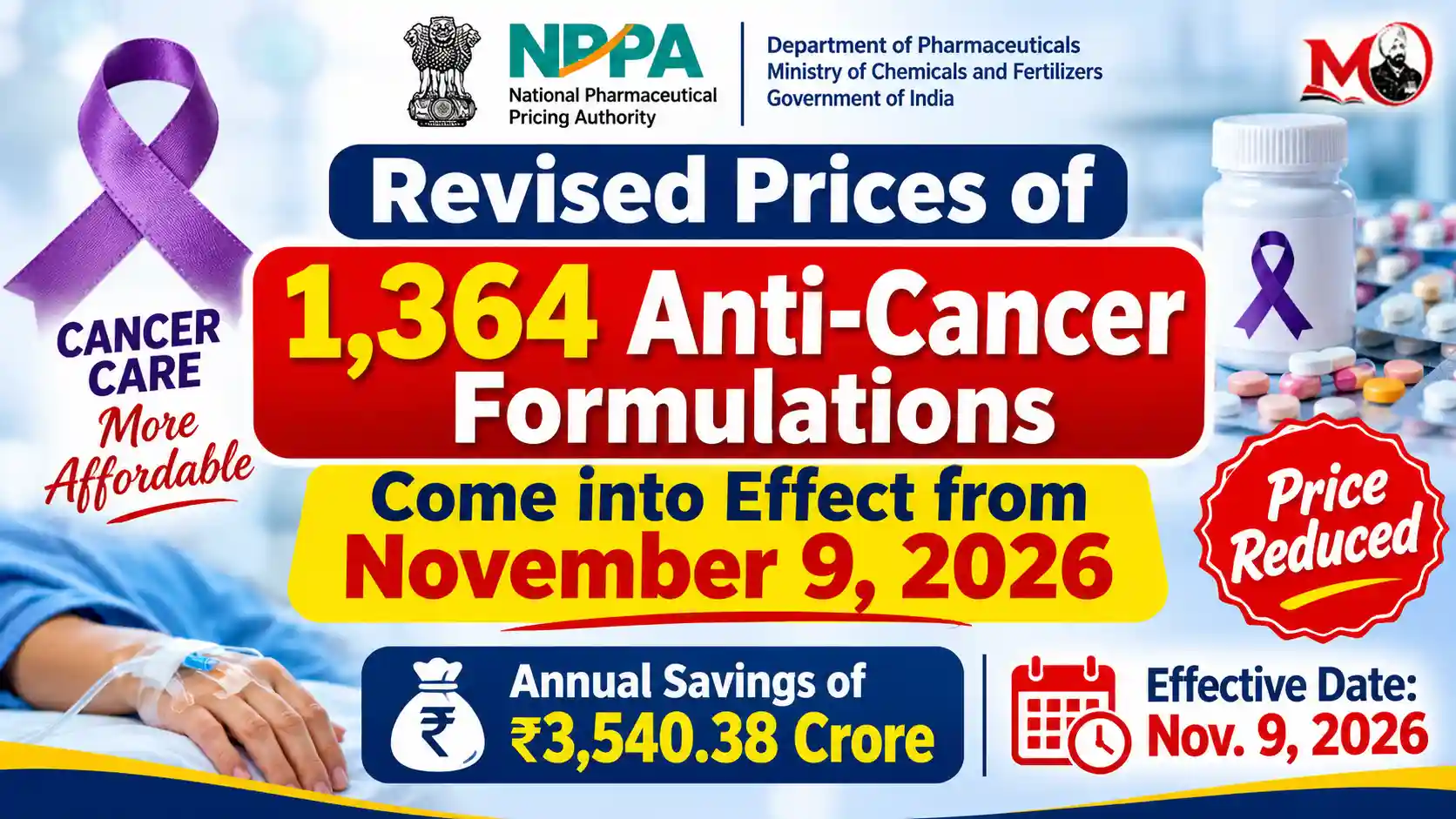
Revised Prices of 1,364 Anti-Cancer Formulations Come into Effect from November 9, 2026
The revised Maximum Retail Prices (MRPs) of 1,364 anti-cancer medicine formulations came into effect across India on November 9, 2026. The initiative has been introduced by the National Pharmaceutical Pricing Authority (NPPA) under the Department of Pharmaceuticals, Ministry of Chemicals and Fertilizers, through its Trade Margin Rationalisation (TMR) mechanism. According to the government, the revised prices are expected to generate estimated annual savings of approximately ₹3,540.38 crore for consumers and provide financial relief to cancer patients and their families.
APPSC Group 2 Recruitment 2026: Post-wiseDetails

NPPA Introduces Trade Margin Rationalisation for 137 Anti-Cancer Drugs
The National Pharmaceutical Pricing Authority has capped trade margins on the Maximum Retail Prices of 137 identified non-scheduled anti-cancer drugs. The decision was based on recommendations made by an Expert Committee constituted by the Directorate General of Health Services (DGHS) under the Ministry of Health and Family Welfare.
The main objective of this initiative is to address excessive trade margins in the distribution and retail channels of anti-cancer medicines. By rationalising these margins, the government aims to reduce the prices paid by patients while maintaining the availability of essential medicines in the market.
NDA Coaching in Patna Bihar for Girls: Eligibility & Tips
The revised prices became effective on November 9, 2026. The measure covers medicines used in the treatment and management of several types of cancer.
1,364 Formulations Across 121 Drugs Report Price Revisions
According to the Department of Pharmaceuticals, as of November 8, 2026, 85 pharmaceutical companies had reported revised MRPs for 1,364 anti-cancer formulations covering 121 drugs.
The government reported that 679 brands recorded price reductions of more than 50 per cent. The highest reported reduction in MRP was 96.45 per cent.
These revisions are expected to reduce the financial burden on patients who require expensive medicines as part of long-term cancer treatment. The estimated annual savings to consumers have been placed at ₹3,540.38 crore.
Examples of Anti-Cancer Medicines With Reduced Prices
Several commonly used anti-cancer medicines have recorded significant reductions in their revised MRPs. Examples published by the Department of Pharmaceuticals include:
- Bevacizumab: Used in the treatment of certain cancers, including lung, colon, ovarian and cervical cancers.
- Denosumab: Used in certain breast and prostate cancer treatment settings to help prevent bone loss.
- Abiraterone Acetate: Used in the treatment of prostate cancer.
- Pegfilgrastim: Helps prevent neutropenia, a condition involving low levels of neutrophils, in cancer patients.
- Azacitidine: Used in the treatment of certain blood cancers.
- Enzalutamide: Used in the treatment of prostate cancer.
- Fulvestrant: Used in the treatment of certain types of breast cancer.
- Palbociclib: Used in the treatment of certain types of breast cancer.
The actual price reduction varies by medicine, brand, formulation and strength. Consumers should check the applicable revised MRP for the exact product they purchase.
What Is Trade Margin Rationalisation?
Trade Margin Rationalisation is a regulatory mechanism used to control excessive margins charged at different stages of the pharmaceutical distribution chain.
In the case of the anti-cancer medicines covered by this initiative, the NPPA has capped the permissible trade margin at 30 per cent. This measure seeks to make medicines more affordable by limiting excessive mark-ups between manufacturers and the retail or hospital supply chain.
The initiative applies to the identified non-scheduled anti-cancer medicines. It is intended to improve affordability without disrupting the legitimate supply of medicines.
Role of the National Pharmaceutical Pricing Authority (NPPA)
The National Pharmaceutical Pricing Authority is a government regulatory body responsible for monitoring and regulating the prices of pharmaceutical drugs in India.
It functions under the Department of Pharmaceuticals, Ministry of Chemicals and Fertilizers. Its responsibilities include implementing drug price control provisions, monitoring medicine prices and ensuring that consumers are not charged above the applicable permitted prices.
The NPPA also monitors compliance with the Drugs (Prices Control) Order, 2013.
How Can Consumers Check Revised Anti-Cancer Medicine Prices?
Consumers can verify the revised prices through the following methods:
- Check the revised MRP printed on the medicine pack.
- Use the Pharma Sahi Daam mobile application to verify medicine prices.
- Visit the official NPPA website at https://nppa.gov.in.
- Compare the medicine’s name, brand, strength and formulation before confirming its applicable price.
Retailers, dealers, hospitals and medical institutions are required to display the revised MRP lists. State Drug Controllers are responsible for monitoring compliance among manufacturers, distributors, retailers and healthcare institutions.
Consumers can report overcharging or pricing-related violations through the Pharma Jan Samadhan portal or contact the NPPA helpline at 1800-11-1255.
Significance of the Decision for India’s Healthcare Sector
Cancer treatment can involve substantial expenditure on medicines, hospitalisation, diagnostic tests and other medical services. High medicine prices can create financial difficulties for patients and their families, particularly those requiring prolonged treatment.
The revised anti-cancer medicine prices represent an important step towards improving access to essential cancer medicines. By controlling excessive trade margins, the government aims to reduce out-of-pocket expenditure and support more affordable healthcare.
The initiative also highlights the role of pharmaceutical price regulation in promoting equitable access to essential medicines across the country.
Key Facts for Competitive Examinations
- Authority: National Pharmaceutical Pricing Authority (NPPA)
- Parent Department: Department of Pharmaceuticals
- Parent Ministry: Ministry of Chemicals and Fertilizers
- Drugs Covered Under TMR: 137 identified anti-cancer drugs
- Revised Formulations Reported: 1,364
- Number of Drugs Covered by Reported Formulations: 121
- Companies Reporting Revised MRPs: 85
- Brands With More Than 50% Price Reduction: 679
- Highest Reported Price Reduction: 96.45%
- Estimated Annual Consumer Savings: ₹3,540.38 crore
- Effective Date: November 9, 2026
- Permissible Trade Margin Cap: 30%
Conclusion
The revision of prices for 1,364 anti-cancer formulations is a significant step towards making cancer treatment more affordable in India. Through the Trade Margin Rationalisation mechanism, the NPPA aims to control excessive trade margins and improve access to essential medicines. The estimated annual savings of ₹3,540.38 crore could provide substantial financial relief to patients and their families.
Source: Press Information Bureau (PIB), Department of Pharmaceuticals, Government of India; National Pharmaceutical Pricing Authority (NPPA).