
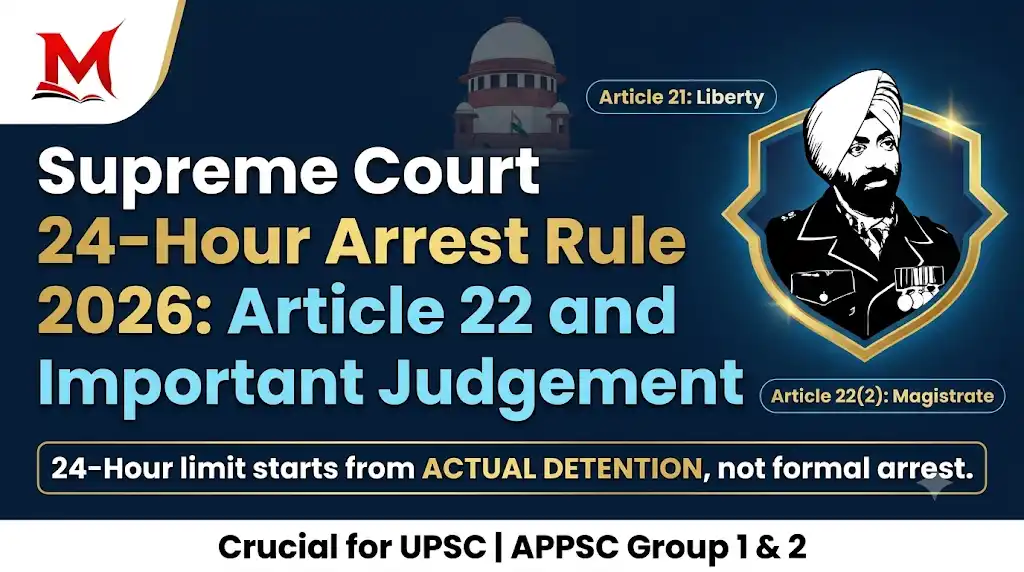
The Supreme Court of India has delivered an important judgement concerning the constitutional protection available to individuals during police detention.On November 5, 2026, the Supreme Court clarified that the 24-hour period for producing an arrested person before a magistrate begins from the moment of actual detention, when the individual’s liberty is restrictedThe deadline cannot be calculated merely from the time when the investigating agency formally records the arrest.The ruling strengthens the constitutional safeguards provided under Article 22(2) of the Indian Constitution and aims to prevent the misuse of police detention procedures.The judgement was delivered by a Bench comprising Justice Ujjal Bhuyan and Justice Atul S. Chandurkar in the case of Sujit Das v. Union of India.
What Does Article 22(2) of the Indian Constitution Say?
Article 22 of the Indian Constitution provides important safeguards against arbitrary arrest and detention.
Article 22(2) specifically states that every person who is arrested and detained in custody must be produced before the nearest magistrate within 24 hours of such arrest.The time required for travelling from the place of arrest to the magistrate’s court is excluded from this calculation.The provision also states that no person can be detained beyond this period without the authority of a magistrate.This constitutional protection is intended to prevent unlawful detention and safeguard individual liberty.

APPSC Group 2 Exam 2026: Syllabus &Preparation Guide
What Is the Supreme Court’s Latest Ruling?
The Supreme Court clarified that the 24-hour period begins when a person’s liberty is actually restricted through detention.
The investigating agency cannot delay the beginning of the constitutional time limit by postponing the formal recording of arrest.
The court rejected the artificial distinction between actual detention and formal arrest for calculating the 24-hour constitutional deadline.
According to the judgement, detention and arrest cannot be treated as separate periods when an individual’s liberty has already been curtailed.
The court also held that detention beyond 24 hours without production before a magistrate is unconstitutional, subject to the legally permitted exclusion of necessary travel time.
Why Did the Supreme Court Deliver This Judgement?
The case involved individuals accused in a matter registered under the Narcotic Drugs and Psychotropic Substances (NDPS) Act.
The accused argued that they had been detained earlier but were formally shown as arrested at a later time.
The difference between the actual detention time and the formally recorded arrest time became important in determining whether the constitutional 24-hour requirement had been violated.
The Supreme Court examined the constitutional safeguards and clarified that the time limit must be calculated from the moment of actual detention.
The judgement also highlighted the importance of protecting individuals against unlawful detention and custodial violence.
Important Constitutional Provisions Related to Arrest
Candidates preparing for competitive examinations should understand the following constitutional provisions:
Article 21 – Right to Life and Personal Liberty
Article 21 states that no person shall be deprived of life or personal liberty except according to the procedure established by law.
Article 22(1) – Rights of Arrested Persons
An arrested person has the right to be informed of the grounds of arrest and the right to consult and be defended by a legal practitioner of their choice.
Article 22(2) – Production Before Magistrate
Every arrested and detained person must be produced before the nearest magistrate within 24 hours of arrest, excluding the time necessary for travelling to the court.
Key Highlights of the Supreme Court Judgement
- The 24-hour period begins from actual detention.
- Formal recording of arrest cannot delay the constitutional deadline.
- Actual restriction of personal liberty is an important factor.
- Detention beyond the permitted period without magistrate authorisation is unconstitutional.
- Necessary travel time to reach the magistrate’s court is excluded.
- The judgement strengthens safeguards against arbitrary detention.
Why Is This Judgement Important for Indian Polity?
The ruling is important for protecting fundamental rights and ensuring accountability in police investigations.
It reinforces the principle that constitutional safeguards cannot be bypassed through administrative procedures.
The judgement also strengthens judicial oversight over police detention and reinforces the importance of personal liberty under the Indian Constitution.
Importance for UPSC, APPSC Group 1 and Group 2
This judgement is particularly important for the Indian Polity and Constitution sections of competitive examinations.
Candidates should focus on:
- Article 21 of the Indian Constitution.
- Article 22(1) and Article 22(2).
- Fundamental rights against arbitrary arrest.
- Constitutional protection against illegal detention.
- Role of magistrates in police remand.
- Difference between actual detention and formal arrest.
- Supreme Court’s role in protecting fundamental rights.