
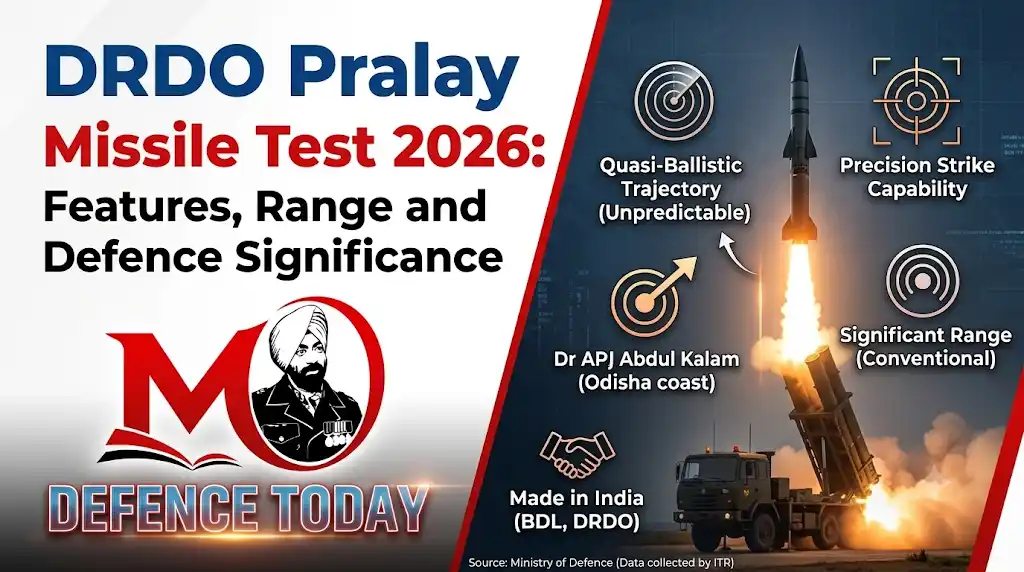
India has achieved another important milestone in its defence technology development with the successful flight test of the indigenous Pralay quasi-ballistic missile.The Defence Research and Development Organisation (DRDO) conducted the successful test on November 5, 2026, from Dr APJ Abdul Kalam Island off the coast of Odisha.The missile was tested at approximately 11:10 AM as part of user evaluation trials. According to the Ministry of Defence, all the test objectives were successfully achieved, based on the data collected by various range instruments deployed by the Integrated Test Range (ITR), Chandipur.The successful test marks an important step towards the induction of the Pralay missile into India’s armed forces.

APPSC Group 2 Exam 2026: Syllabus &Preparation Guide
What Is the Pralay Missile?
Pralay is an indigenously developed quasi-ballistic missile designed to strengthen India’s conventional military capabilities.
It has been developed by the Defence Research and Development Organisation (DRDO) with the involvement of Research Centre Imarat, Hyderabad, and other DRDO laboratories.
The missile is designed to provide precision-strike capabilities against selected military targets.
Unlike traditional ballistic missiles that follow a relatively predictable trajectory, quasi-ballistic missiles can manoeuvre during flight, making their trajectories less predictable.
This capability can create additional challenges for enemy air defence systems.
Important Features of the Pralay Missile
Some of the important features of the Pralay missile include:
1. Indigenous Development
Pralay has been developed using India’s domestic defence research and engineering capabilities. Research Centre Imarat, Hyderabad, played an important role in its development along with other DRDO laboratories.
2. Quasi-Ballistic Technology
The missile uses a quasi-ballistic flight profile, allowing manoeuvring during its trajectory.
3. Precision Strike Capability
The missile is designed to engage designated targets with high precision.
4. Conventional Military Role
Pralay is intended to strengthen India’s conventional strike capabilities.
5. Advanced Missile Technologies
The system incorporates advanced technologies to improve operational effectiveness and military preparedness.
Where Was the Pralay Missile Tested?
The successful flight test was conducted from Dr APJ Abdul Kalam Island, located off the Odisha coast.
The Integrated Test Range (ITR), Chandipur, monitored the test through its range instrumentation systems.
The test was witnessed by senior DRDO officials, representatives from the defence industry and members of the Indian Armed Forces.
Organisations Involved in the Development of Pralay
The missile programme involves important Indian defence organisations.
- DRDO: The main research and development organisation.
- Research Centre Imarat: Hyderabad-based DRDO laboratory involved in missile development.
- Bharat Dynamics Limited: One of the development-cum-production partners responsible for producing the missile system.
- Integrated Test Range: Responsible for monitoring and collecting test data during the flight test.
Why Is the Pralay Missile Important for India’s Defence?
The successful test is significant for India’s efforts to strengthen its indigenous defence capabilities.
The missile can contribute to India’s conventional military preparedness by providing an advanced precision-strike system.
It also demonstrates the growing technological capabilities of Indian defence research institutions and domestic defence manufacturers.
The development supports the broader objective of Atmanirbhar Bharat in defence manufacturing.
Importance of Pralay Missile for UPSC, APPSC, NDA and CDS
Candidates preparing for competitive examinations should remember the following facts:
- Missile Name: Pralay.
- Missile Category: Quasi-ballistic missile.
- Developing Organisation: DRDO.
- Important Development Laboratory: Research Centre Imarat, Hyderabad.
- Production Partner: Bharat Dynamics Limited.
- Test Date: November 5, 2026.
- Test Location: Dr APJ Abdul Kalam Island, Odisha.
- Monitoring Facility: Integrated Test Range, Chandipur.
These details are relevant to Defence Current Affairs, Science and Technology and India’s indigenous defence programmes.