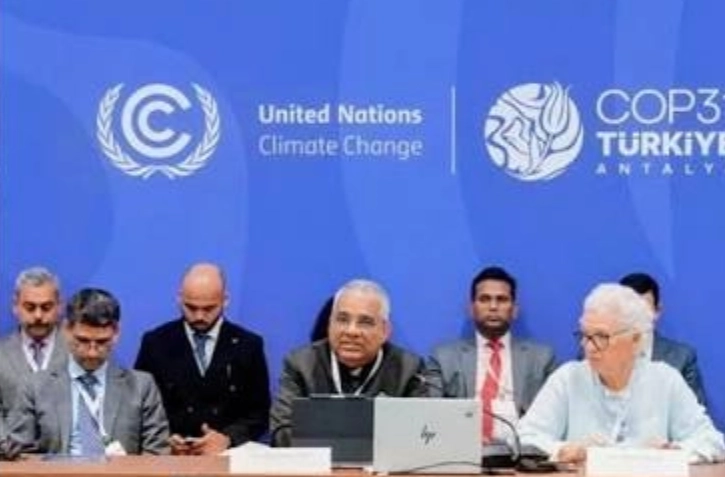
India and Sweden have launched the third phase of the Leadership Group for Industry Transition, known as LeadIT 3.0, at the 31st United Nations Climate Change Conference (COP31) in Antalya, Türkiye, on 17 November 2026.
The initiative aims to accelerate the transition towards low-carbon industries by promoting clean technologies, mobilising investments and strengthening international cooperation. Union Minister for Environment, Forest and Climate Change Bhupender Yadav announced the launch during the Industry Leaders’ Roundtable at COP31.
APPSC Group 2 Notification 2026: 720 Vacancies Announced

Sweden was represented by Helena Dyrssen, State Secretary in the Ministry of Climate and Enterprise. The launch marks another important step in India–Sweden cooperation on climate action and sustainable industrial development.
What is LeadIT?
The Leadership Group for Industry Transition (LeadIT) is a global initiative established by India and Sweden in 2019.
It brings together governments, industries and other stakeholders to accelerate the transition of energy-intensive industrial sectors towards low-carbon production.
Industries such as steel, cement and heavy transport contribute significantly to global greenhouse gas emissions. LeadIT supports the development and adoption of cleaner technologies to reduce these emissions while maintaining industrial growth and competitiveness.
The initiative currently brings together 20 countries and 33 companies. Brazil has joined as its newest country member.
Key Objectives of LeadIT 3.0
LeadIT 3.0 will cover the period from 2027 to 2030. Unlike earlier phases, which focused significantly on building partnerships and knowledge-sharing, the new phase aims to scale industrial projects and deliver practical results.
Its three major priorities are:
1. Technology Development and Diffusion
The initiative will encourage the development, demonstration and adoption of clean industrial technologies.
It will support collaboration between countries, companies and technology providers to accelerate industrial decarbonisation.
Important areas include:
- Hydrogen-based iron production.
- Electrification of industrial heating.
- Carbon capture and utilisation.
- Cleaner cement manufacturing.
- Industrial recycling and circular economy solutions.
2. Mobilisation of Capital and Investment
The second priority is to improve access to finance for low-carbon industrial projects.
LeadIT 3.0 will work towards connecting industrial projects with financial institutions and investors. It will also support project preparation and risk reduction to encourage greater investment in clean technologies.
3. Capacity Building and Policy Support
The third priority focuses on strengthening the technical and institutional capabilities of governments and industries.
It will support policy development, carbon markets, workforce skills and international cooperation.
The initiative also aims to ensure that the industrial transition creates opportunities for workers, communities and developing economies.
India’s Progress in Climate Action
During the launch, Union Minister Bhupender Yadav highlighted India’s achievements in climate action and sustainable development.
According to the government announcement:
- India achieved a 37.38% reduction in emissions intensity between 2005 and 2022.
- The country reached 50% of its installed electricity capacity from non-fossil fuel-based sources, five years ahead of its target.
- India’s additional forest carbon sink reached approximately 2.44 billion tonnes of carbon dioxide equivalent.
These developments demonstrate India’s efforts to balance economic growth with environmental sustainability.
Importance of India–Sweden Cooperation
India and Sweden launched LeadIT in 2019 to promote international cooperation in transforming heavy industries.
The second phase supported 11 pre-pilot projects in the steel and cement sectors under the India–Sweden Industry Transition Partnership. Cooperation also expanded into low-carbon heavy-duty transport.
With LeadIT 3.0, both countries aim to move beyond discussions and feasibility studies towards large-scale industrial implementation.
Brazil’s entry into the initiative is also expected to strengthen the participation of developing countries and encourage South–South cooperation.
What is COP31?
COP31 refers to the 31st Conference of the Parties to the United Nations Framework Convention on Climate Change (UNFCCC).
It is an international climate conference where countries discuss climate change mitigation, adaptation, climate finance and global cooperation.
COP31 is being held in Antalya, Türkiye, in 2026. The launch of LeadIT 3.0 at the conference highlights the growing importance of industrial decarbonisation in global climate discussions.
Significance of LeadIT 3.0
Industrial decarbonisation is essential to achieving global climate goals. Steel, cement and heavy transport are important for economic development but also present major challenges in reducing carbon emissions.
LeadIT 3.0 can help countries adopt cleaner production methods, attract green investments and develop advanced industrial technologies.
For India, the initiative provides opportunities to strengthen manufacturing competitiveness, promote innovation and support sustainable economic growth.
Conclusion
The launch of LeadIT 3.0 by India and Sweden at COP31 represents an important development in international climate cooperation. By focusing on technology development, investment mobilisation and capacity building, the initiative aims to accelerate the transition towards cleaner and more competitive industries.
The new phase, covering 2027–2030, reflects a shift from commitments and partnerships towards practical implementation and measurable industrial outcomes.
Important Exam Points
- Full form: Leadership Group for Industry Transition
- LeadIT launched: 2019
- Founding countries: India and Sweden
- LeadIT 3.0 launched: 17 November 2026
- Venue: COP31, Antalya, Türkiye
- LeadIT 3.0 period: 2027–2030
- Newest country member: Brazil
- Membership: 20 countries and 33 companies
- Key sectors: Steel, cement and transport
- Three priorities: Technology development, capital mobilisation and capacity building
- Indian Minister: Bhupender Yadav