
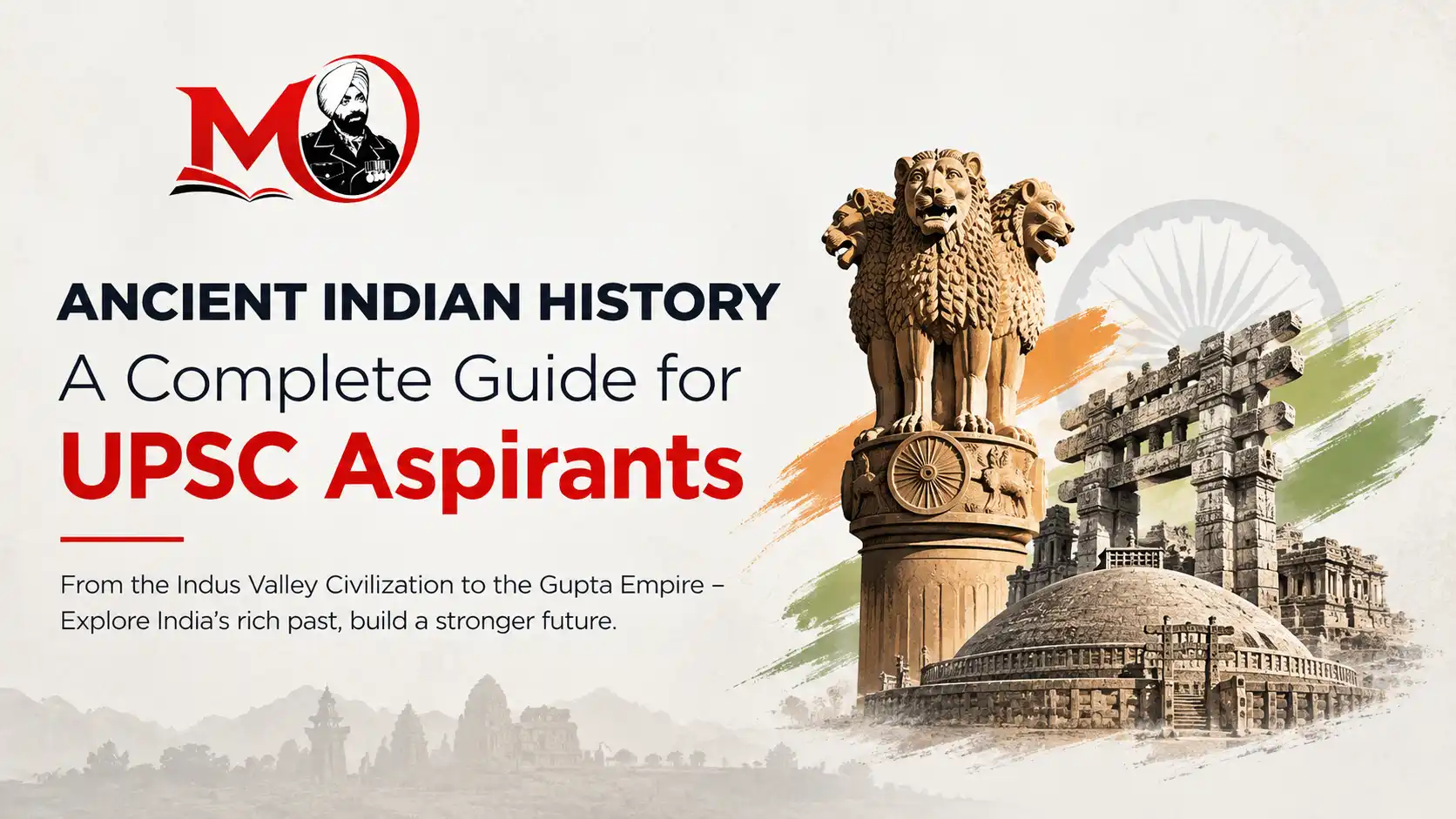
Introduction to Ancient Indian History
Ancient Indian History is an important subject for students preparing for the UPSC Civil Services Examination and other competitive exams. It helps aspirants understand the development of Indian civilization, political systems, religious traditions, economic activities, art, architecture, and cultural heritage. From the Indus Valley Civilization to the rise of powerful dynasties such as the Mauryas, Guptas, and Satavahanas, ancient India witnessed remarkable developments that shaped the country’s identity.
For UPSC aspirants, studying ancient Indian history is not limited to memorizing dates and names. It involves understanding historical events, archaeological evidence, religious movements, and the contributions of different rulers and civilizations.
1. Indus Valley Civilization
The Indus Valley Civilization, also known as the Harappan Civilization, was one of the earliest urban civilizations in the world. It flourished around 2600 BCE to 1900 BCE, with important sites such as Harappa, Mohenjo-daro, Dholavira, and Lothal.
The civilization was known for its well-planned cities, drainage systems, brick houses, trade networks, and standardized weights and measures. Archaeological discoveries indicate that its people engaged in agriculture, handicrafts, and long-distance trade.
The decline of the Harappan Civilization remains an important topic for historical research. Climate change, environmental transformations, and changes in river systems are among the explanations discussed by historians.
2. Vedic Period
The Vedic Period is an important phase in ancient Indian history, generally studied in two parts: the Early Vedic Period and the Later Vedic Period.
The Vedas are among the most important literary sources for understanding this period. Society, economy, religious practices, and political institutions gradually changed over time. Agriculture became increasingly important, settlements expanded, and social structures became more complex.
For UPSC preparation, candidates should understand the differences between the Early and Later Vedic periods, the significance of the Vedas, and the evolution of political and social institutions.
3. Rise of Buddhism and Jainism
Buddhism and Jainism emerged around the sixth century BCE, during a period of significant social, economic, and intellectual change in ancient India.
Gautama Buddha founded Buddhism, emphasizing the Four Noble Truths, the Eightfold Path, compassion, and the path toward liberation from suffering.
Mahavira, the 24th Tirthankara of Jainism, emphasized non-violence, truth, non-possessiveness, and self-discipline.
Both religions influenced Indian philosophy, art, architecture, and society. Their teachings also encouraged the development of monasteries and religious learning centres.
UPSC aspirants should study the teachings of Buddha and Mahavira, Buddhist councils, important religious sites, and the spread of these traditions under various rulers.
4. Mauryan Empire
The Mauryan Empire was one of the largest and most influential empires in ancient India. Founded by Chandragupta Maurya in the fourth century BCE, it expanded under his successors.
Emperor Ashoka is particularly significant because of his transformation following the Kalinga War. He promoted Dhamma, moral conduct, religious tolerance, and public welfare. His inscriptions, found across different parts of the Indian subcontinent, provide valuable evidence about Mauryan administration and policies.
The Arthashastra, traditionally associated with Kautilya, is another important source for understanding ancient Indian political thought and administration.
Important UPSC topics include Mauryan governance, Ashoka’s inscriptions, the Kalinga War, taxation, and the causes behind the empire’s decline.
5. The Satavahana Dynasty
The Satavahanas played an important role in the history of the Deccan region, particularly in areas associated with present-day Maharashtra, Telangana, and Andhra Pradesh.
Simuka is generally regarded as the founder of the Satavahana dynasty. Gautamiputra Satakarni was one of its most prominent rulers. The dynasty contributed to regional administration, trade, coinage, religious patronage, and cultural development.
Pratishthana, identified with modern Paithan, was an important political centre. Dhanyakataka and other Deccan centres also played significant roles in the region’s historical and cultural development.
The Satavahana period is associated with trade networks, the use of Prakrit in inscriptions, donations to Buddhist establishments, and the development of rock-cut architecture.
For competitive examinations, aspirants should focus on important rulers, inscriptions, coins, trade, religious patronage, and the dynasty’s connections with the Deccan region.
6. Gupta Empire and Cultural Achievements
The Gupta Empire, which rose to prominence in the fourth century CE, is often associated with major developments in Indian literature, mathematics, astronomy, sculpture, and other cultural fields.
Rulers such as Chandragupta I, Samudragupta, and Chandragupta II contributed to the expansion and influence of the empire.
The period witnessed achievements in Sanskrit literature, scientific thought, and artistic traditions. Scholars such as Aryabhata made important contributions to mathematics and astronomy.
However, the extent and nature of these achievements varied across regions and fields. UPSC aspirants should examine the political history of the Guptas alongside their contributions to science, literature, religion, and art.
7. Art, Architecture, and Historical Sources
Ancient Indian history can be understood through literary sources, inscriptions, coins, monuments, and archaeological discoveries.
Important examples include the Sanchi Stupa, the Ajanta Caves, Ashokan pillars, and ancient temple remains. These monuments provide evidence of religious practices, artistic styles, craftsmanship, and patronage.
Literary sources such as the Vedas, Buddhist texts, Jain literature, and works associated with ancient political thought also help historians reconstruct the past.
For UPSC preparation, connecting historical sources with the rulers, regions, and periods they represent is an effective study strategy.
Conclusion
Ancient Indian History is an essential part of UPSC preparation because it builds a foundation for understanding India’s political, social, religious, and cultural evolution. From the urban planning of the Indus Valley Civilization to the achievements of the Mauryas, Satavahanas, and Guptas, each period offers valuable insights into the country’s past.
A systematic study of historical timelines, important dynasties, religious movements, inscriptions, and archaeological sites can help aspirants prepare effectively for competitive examinations. Combining NCERT textbooks with revision notes and previous years’ UPSC questions is a practical way to strengthen conceptual understanding and improve performance.