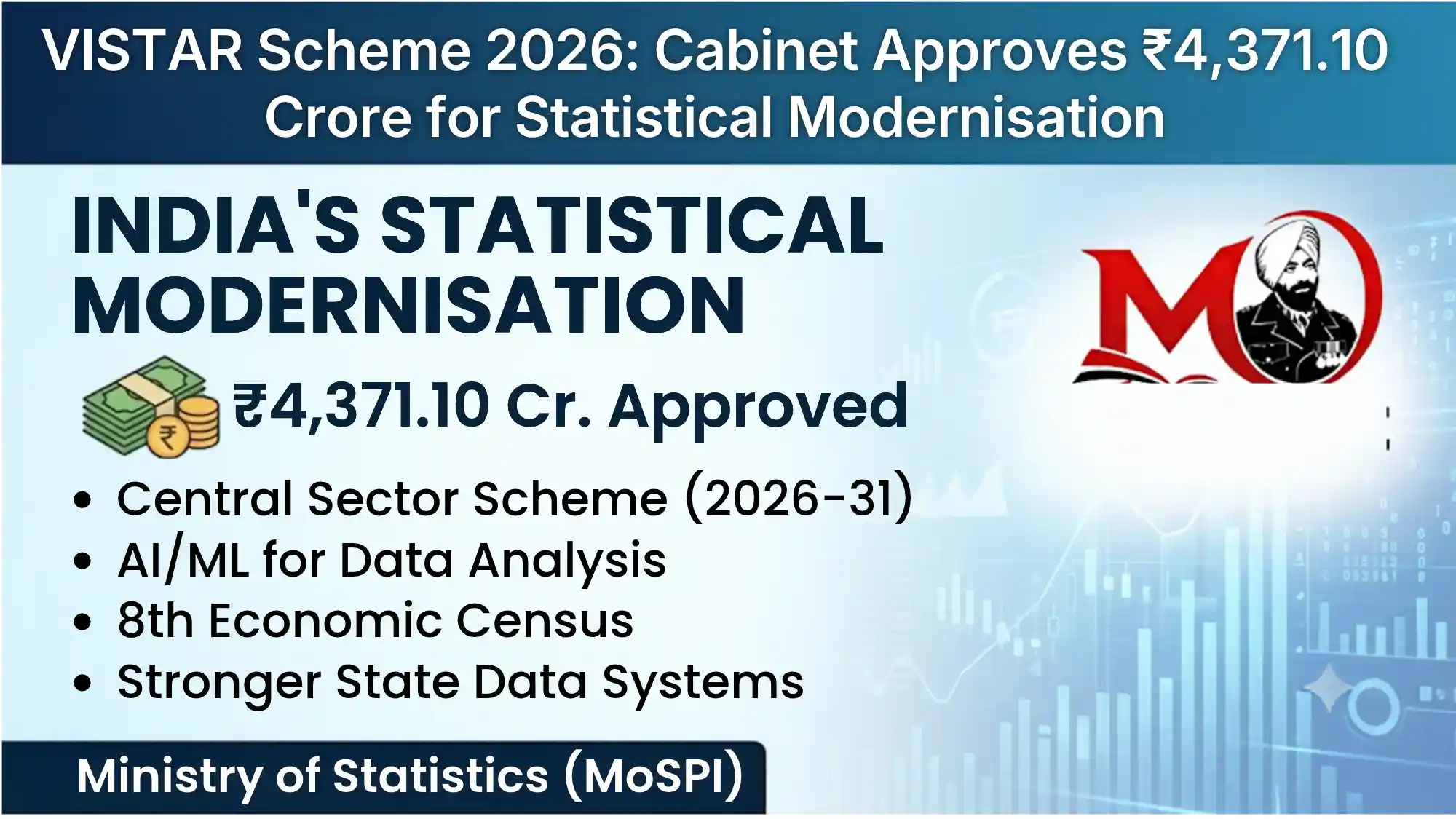
The Union Cabinet has approved a major initiative to modernise India’s statistical system through the Viksit Bharat Initiative for Statistical Transformation, Analytics and Research (VISTAR).The scheme has been approved for five financial years, from 2026-27 to 2030-31, with a total financial allocation of ₹4,371.10 crore.The initiative is designed to improve the quality, accuracy, accessibility and timeliness of official statistical information in India.The Ministry of Statistics and Programme Implementation (MoSPI) will play a central role in implementing the programme.
APPSC Group 2 Exam 2026: Syllabus &Preparation Guide
What Is the VISTAR Scheme?
VISTAR stands for Viksit Bharat Initiative for Statistical Transformation, Analytics and Research.
It is a Central Sector Scheme intended to strengthen India’s official statistical infrastructure.
The scheme focuses on modernising data collection, improving statistical research, introducing advanced digital technologies and developing better systems for data processing and analysis.
It is aligned with the broader vision of Viksit Bharat 2047.
The initiative is expected to help policymakers access reliable and timely information for planning and decision-making.
Key Highlights of VISTAR Scheme 2026
| Particulars | Details |
|---|---|
| Scheme Name | VISTAR |
| Full Form | Viksit Bharat Initiative for Statistical Transformation, Analytics and Research |
| Approved By | Union Cabinet |
| Implementing Ministry | Ministry of Statistics and Programme Implementation |
| Total Outlay | ₹4,371.10 Crore |
| Duration | 2026-27 to 2030-31 |
| Scheme Category | Central Sector Scheme |
| Main Objective | Modernisation of India’s Statistical System |
Three Major Components of the VISTAR Scheme
The scheme consists of three important components.
1. Comprehensive Statistical Operations and Strengthening of Ecosystem
This component aims to improve the collection, processing and dissemination of statistical information.
The government plans to conduct 59 surveys during the 16th Finance Commission cycle, compared with 43 major surveys conducted previously.
The initiative will also focus on:
- Digitalisation of statistical processes.
- Improved data collection methods.
- Artificial Intelligence and Machine Learning applications.
- Better data validation and processing.
- Improved accessibility of official statistical information.
2. Support for Statistical Strengthening (SSS)
The second component focuses on improving the statistical capabilities of State and Union Territory governments.
Under the redesigned Support for Statistical Strengthening framework, financial and technical assistance will be provided to strengthen state-level data systems.
The main objectives include:
- Generating reliable district-level statistical information.
- Improving State and District Domestic Product estimates.
- Strengthening state-level statistical institutions.
- Improving data collection and processing infrastructure.
- Supporting evidence-based policy decisions.
This component is particularly important for states that need better statistical infrastructure for development planning.
3. Economic Census
The third component focuses on conducting the 8th Economic Census in collaboration with State and Union Territory governments.
The Economic Census will collect information about non-farm establishments and the workers employed in them.
It is expected to provide detailed information up to the Gram Panchayat and Ward levels.
The data will help policymakers understand the structure of India’s business and unorganised economic sectors.
It will also support the development of a National Statistical Business Register.
Role of Artificial Intelligence in the VISTAR Scheme
One of the important features of the initiative is the integration of modern technologies into India’s statistical system.
Artificial Intelligence and Machine Learning will be used to improve data processing, validation and analysis.
The scheme also aims to make official datasets more interoperable and machine-readable.
Alternative data sources such as mobile phone data, scanner information and e-commerce data may complement traditional surveys.
These technologies can help reduce data collection gaps and improve the quality of statistical outputs.
Why Is the VISTAR Scheme Important for India’s Economy?
Reliable statistical information is essential for economic planning and governance.
The government uses official data to formulate policies, measure economic performance and evaluate development programmes.
The VISTAR Scheme aims to improve the availability of accurate and detailed information.
Its potential benefits include:
- Better economic planning.
- Improved quality of official statistics.
- Stronger State and District-level data systems.
- Better understanding of the unorganised sector.
- Improved digital governance.
- Evidence-based policy formulation.
Importance of VISTAR Scheme for UPSC and APPSC Examinations
The VISTAR Scheme is relevant to the Indian Economy and Government Schemes sections of competitive examinations.
Candidates should remember the following points:
- Full form of VISTAR.
- Total financial allocation of ₹4,371.10 crore.
- Implementation period of 2026-27 to 2030-31.
- Ministry responsible for implementation.
- Three components of the scheme.
- 8th Economic Census.
- Use of Artificial Intelligence and Machine Learning.
- Support for Statistical Strengthening.
Conclusion
The VISTAR Scheme 2026 represents an important step towards modernising India’s official statistical system.
With a financial allocation of ₹4,371.10 crore, the initiative aims to strengthen data collection, improve statistical research and introduce advanced technologies into government data systems.
Its implementation can support better economic planning and evidence-based governance in line with the vision of Viksit Bharat 2047.